
Expert reaction to Storm Éowyn
23 January 2025
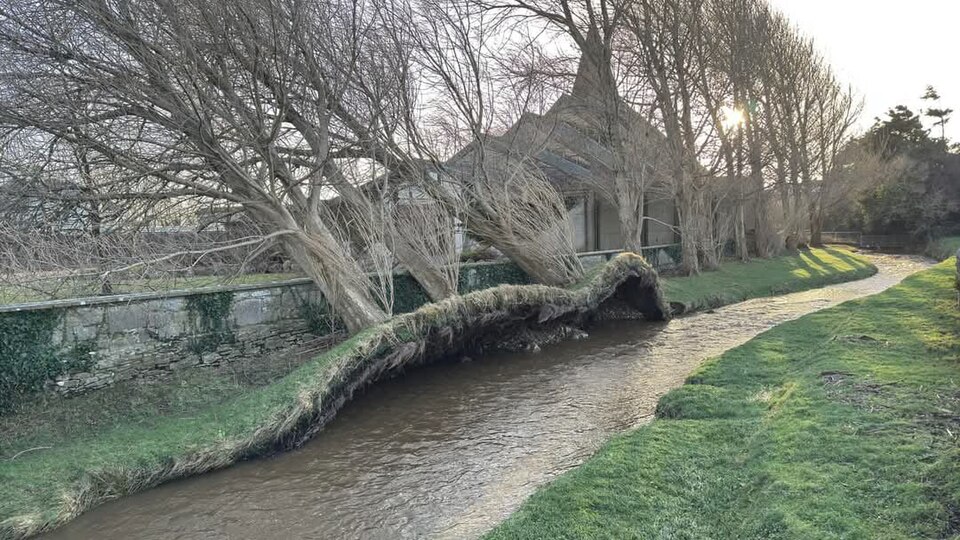
St. Bernard's Church in Abbeydorney following Storm Éowyn. Image by Riversting via wikimedia commons
Irish scientists comment on Storm Eowyn.
Dr Barry Hayes, Associate Professor in Electrical Power Systems, University College Cork, said:
“Trees falling can certainly damage the electrical infrastructure, but storms also cause electricity poles to be damaged or toppled. High winds can cause electricity lines to come into contact with each other resulting in electrical faults, and debris from the storm coming into contact with the electrical infrastructure also causes faults.
“This is a particular issue in rural parts of the country (Ireland) where the electrical distribution network is made up almost entirely of overhead lines that are exposed to the weather. In cities, more of the electrical infrastructure is underground, so we don’t have as many outages.
“In an event as extreme as Storm Éowyn, there can be damage to larger electrical infrastructure too, e.g., substations, transmission pylons etc.
“ESB Networks dispatch repair crews to fix damaged overhead lines. This is a record number of outages recorded in the country and ESB crews will work day and night over the next week or so to restore power to everyone. Prioritisation is usually given to restoring parts of the network that serve the largest numbers of customers, so if you are in a very isolated location (e.g., at the end of a long electrical line and far from the nearest substation), this can take longer.
“The best solution to making the grid more resilient to storms is undergrounding the distribution network infrastructure. There are many efforts ongoing internationally to convert overhead lines to underground cables for this reason. However, in Ireland this is very expensive to do since we have a relatively low population density and a geographically scattered population outside our main cities. The costs of undergrounding on a nationwide scale would be enormous. Backup generators, batteries, and other forms of energy storage can help make in making us more resilient, particularly in rural areas.
“Always assume fallen electricity lines are live and stay well away from them. Also be patient and supportive to ESB repair crews even if you are frustrated with being without power for a long time – their job is very difficult and dangerous.”
Declarations of interest: none received
Dr Paul Cuffe, Assistant Professor, School of Electrical and Electronic Engineering, University College Dublin, said:
“Storms cause localised power outages because of the damage they do to the electricity distribution system. These assets, which in Ireland are owned and operated by ESB Networks, bring electricity from the backbone transmission grid (operated by Eirgrid) out to the homes and businesses that need it. These distribution circuits act like local and regional roads whereas the transmission grid is akin to our national motorway network. Distribution circuits are usually overhead lines, and these are prone to storm damage: trees can be blown into contact with conductors, or poles can collapse, amidst other hazards, and these will cause sudden electrical disturbances. ESB Networks uses sophisticated devices, called protective relays, that can detect if something strange happens to the flow of electricity along a distribution line, which can indicate a dangerous short circuit situation. When this happens the powerline is immediately and automatically de-energised to avoid hazards to life and property. Unfortunately, this response will sever the supply to all the homes that had been relying on that local line to bring them electricity, and they usually won’t get their supply back until a crew has been dispatched in a van to diagnose and remediate whatever mishap befell the powerline.”
Declarations of interest: none received
Dr Eugene Farrell, Associate Professor, School of Geography, Archaeology and Irish Studies, University of Galway, said:
“Storm Éowyn is another visible piece of evidence that changing ocean climates in the Atlantic have the potential to generate extreme storm and hurricane events. Rising sea levels and intensified storms are already posing significant threat to the livelihoods of coastal communities in Ireland. We have to acknowledge that a sea-level rise of up to 1 metre is now locked-in for Ireland and will take decades, or even centuries, to stop – even if the EU meets its aim to be climate-neutral by 2050. This has very serious implications for our coasts and will increase the rates of irreversible shoreline erosion and lead to more frequent and severe flooding events.
“Part of the research by Geographers in University of Galway and the Ryan Institute is to monitor coastal change from storms and to co-design potential solutions with concerned coastal groups and local authorities. New research shows how restoring our dune fields, tidal wetlands, oyster beds, seagrass beds and kelp beds can build resilience to extreme weather events by providing natural buffers from high-energy storm surges. The good defence against storm surge is to have a healthy dune system or wide tidal wetland in front of coastal infrastructure to dissipate the storm energy. Dune-based restoration is happening all around Ireland and most commonly involve planting marram grasses on degraded sand dunes. This intervention stabilizes exposed bare sand areas which reduces erosion risks and enhances biodiversity. A recent report from the Climate Change Advisory Council shows how volunteer coastal communities are working to protect their coasts but are in urgent need of government support. Scaling up nature-based solutions in our marine waters is particularly important in Ireland and Europe, as the Biodiversity Strategy for 2030 mandates that 30% of terrestrial and marine habitats must be protected. For marine habitats (e.g., seagrass beds, kelp forests, shellfish beds) the Nature Restoration Law will require Ireland to have restoration measures in place on at least 30% of the areas not in good condition by 2030.
“Ireland is also required to put in place measures to restore estuarine, coastal, and marine habitats under the EU Marine Strategy Framework Directive (MSFD). It is an opportune time in coastal and marine management in Ireland. If we restore or coastal and marine habitats, we will concurrently build the resilience of coastal communities to storm impacts and rising sea levels. The question that researchers are asked continually by volunteer coastal groups is when will new support structures be created to help these volunteers ‘on the ground’ (dunes and tidal wetlands) or ‘in the sea’ (oyster, seagrass and kelp beds). What we can predict with certainty is that we urgently need ambitious and brave leadership, so that coastal communities do not end up in the sea.
“A recent report from the European Marine Board illustrates the threats of storms and rising sea levels all around Europe. The report provides policy and scientific recommendations to build coastal resilience. Two the recommendations include supporting nature-based solutions and facilitating government bodies to work closely and continuously with coastal community groups and other stakeholder to find solutions. Geographers in University of Galway are working with the Marine Institute, the Department of Housing, Local Government and Heritage, the OPW as well as multiple local authorities around Ireland on solutions to all these recommendations.”
Declarations of interest: none received
Prof Peter Thorne, Professor of Physical Geography, Maynooth University, said:
“The jury is very much out on linking climate change to windstorms. There are vanishingly few studies that have come up with a definitive link on any aspects of windstorms (frequency, intensity) in the midlatitudes. That doesn’t, necessarily, mean that there is no link (absence of evidence is not evidence of absence) but it is important to be honest as to what we don’t know.
The proximal cause of this storm is a record or near record temperature gradient between the SE US and the Atlantic. Many places across a broad swathe of the southern US have broken daily, monthly or even all time cold records. Couple that with a North Atlantic breaking daily records the other way and that temperature gradient supercharges the atmospheric jet. This storm has then coupled with that jet ‘just so’ to enable very explosive cyclogenesis.”
Declarations of interest: none received
Dr Mary Bourke, Associate Professor, Trinity College Dublin, said:
“TCD Geographers are out in the field right now collecting data to assess the real effect of this storm on the erosion of our coastline in Wexford and Dublin.
While the winds are expected to do significant damage to homes and businesses including tree damage or what we call wind throw, the storm is also generating significantly high waves that will have the potential to change our softer (sandier) coastlines, particularly along the East Coast of Ireland.
Coast erosion is a significant problem that engineering will struggle to address. There are some nature based activities Like planting Marram grass and keeping the public away from walking on sand dunes. These natural landforms (dunes and salt marshes) already protect our coastline and we must do what we can to protect these landforms.”
Declarations of interest: none received