
Expert reaction to Heathrow airport closing after fire at nearby electrical substation
21 March 2025
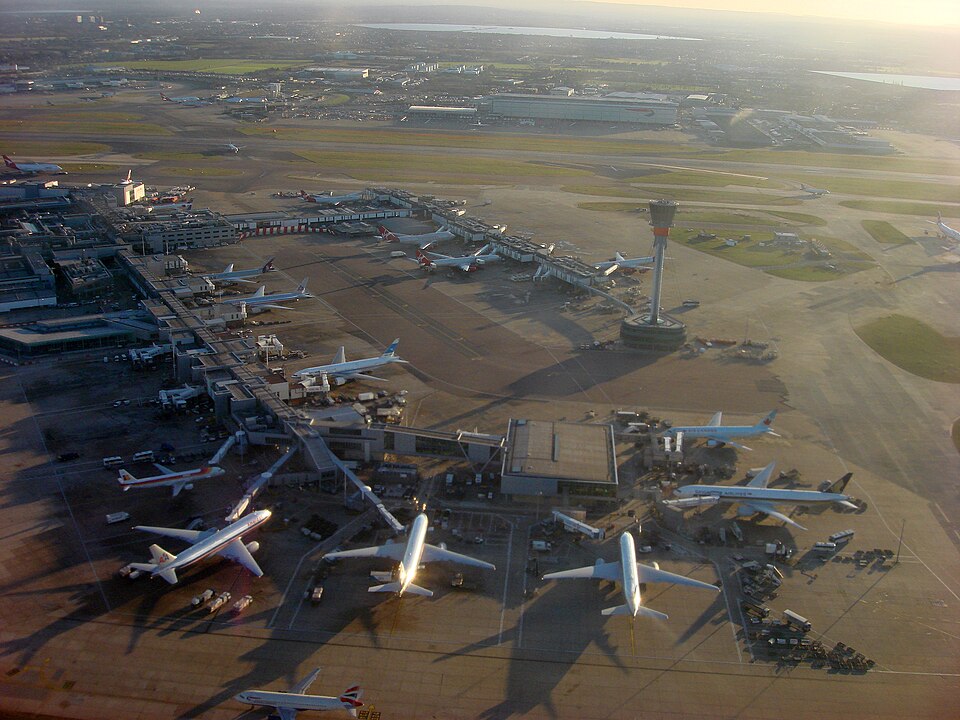
Image by Panhard via Wikimedia Commons
Irish scientists comment on a power outage caused by an electrical substation fire that has caused Heathrow airport to close.
Dr David Laverty, Reader, School of Electronics, Electrical Engineering and Computer Science, Queen’s University Belfast, said:
“What is an electrical substation?
“An electrical substation is a crucial part of the power grid, acting as a hub that transforms high-voltage electricity into lower, usable voltages for homes, businesses, and critical infrastructure like airports. It also plays a key role in controlling and protecting power flows to prevent overloads and blackouts.”
How/why would one substation have such a big impact on an airport? Is that normal / what we would expect from our energy infrastructure?
“Heathrow relies on a steady and high-capacity power supply to run everything from air traffic control to baggage systems. If a key substation goes offline and backup systems aren’t enough to bridge the gap, operations grind to a halt. While major infrastructure is designed with some redundancy, a single point of failure—especially in a high-demand environment—can still have a dramatic impact.”
Are fires at substations common? Is there anything we can tell from this fire?
“Substation fires are rare but not unheard of, often triggered by equipment failure or external damage like weather events. The scale of disruption at Heathrow suggests this was a serious incident, but until investigations are complete, it’s unclear whether it was due to a technical failure or an external factor.”
What sort of things can cause fires at substations – do we know yet what might have caused this one?
“Electrical faults, insulation failures, lightning strikes, or even deliberate tampering can all spark a substation fire. Right now, it’s too early to say what caused this one, but investigators will be looking at everything.”
Is it too early to know what has happened here?
“Yes—engineers will need time to assess the damage, trace the cause, and determine whether the fire was due to a technical issue, an external incident, or something more unusual.”
Some of the information suggests the fire damaged equipment at the substation – what would that equipment be?
“The most vulnerable components would be transformers, circuit breakers, and switchgear—vital for controlling and distributing electricity. If these are badly damaged, it can take days or even weeks to repair or replace them.”
Why do incidents like these cause such significant losses of power?
“Substations act as central hubs in the power network—when one fails, electricity can’t be safely routed to where it’s needed. Heathrow’s demand is enormous, and if alternative power sources aren’t able to take over immediately, the impact is felt within seconds.”
What makes this incident ‘unprecedented’, if it is?
“If this fire caused an extended or widespread outage despite existing safeguards, it could highlight previously unknown weaknesses in the power infrastructure. A failure of this scale, affecting one of the world’s busiest airports, would certainly be a rare event.”
What will the authorities/companies etc. be doing at the moment to try to restore power?
“Engineers will be working around the clock to assess the damage, restore power via alternative routes, and bring in emergency generators where possible. In parallel, investigations will be underway to understand what went wrong and prevent it from happening again.”
What sorts of investigations will be going on to try to work out what happened?
“Specialists will be analysing damaged equipment, reviewing maintenance records and operational data recorded by instruments in the substation. They will also considering external factors like weather conditions. They may also use forensic techniques to pinpoint where the fire started and how it spread.”
Is this an issue specific to aviation and airports or does it just happen that Heathrow was affected because it is supplied by this substation?
“This isn’t just an airport problem—any large facility relying on a single substation could suffer a similar fate. Heathrow was particularly unlucky this time, but the incident raises questions about the resilience of power infrastructure supporting other critical sites.”
Declaration of interests: Current Position: Vice President of Engineering at NovoGrid, a company specialising in grid optimisation technology. Academic Background: PhD Electrical Engineering from University College Dublin (UCD). Professional Affiliation: Chartered Engineer with Engineers Ireland. Previous Employment: Experienced network planner with ESB Networks, the distribution system operator in Ireland. These roles and experiences provide me with relevant expertise in electrical grid systems and infrastructure. However, they may also be perceived as potential sources of bias, particularly my current position at NovoGrid and past employment with ESB Networks. While I have no direct involvement with the Heathrow Airport power infrastructure or the specific substation in question, my professional background in the energy sector could influence my perspective on this incident. I have not received any industry funding for research related to this specific event, nor do I have any current advisory roles or committee memberships directly related to Heathrow Airport or its power supply. My comments are based on publicly available information and my professional expertise.
Dr Paul Cuffe, Assistant Professor, School of Electrical and Electronic Engineering, University College Dublin (UCD), said:
“A substation is where different power lines link together, like a junction on a motorway network. Substations house large electrical transformers that interlink power lines that operate at distinct voltage different voltages: most of the UK’s transmission lines operate at either 400,000 Volts or 275,000 Volts . These high voltage power lines function to transport bulk electrical power around the country. In most substations, there will also be transformers that step down to yet lower voltages; these withdraw power from the national grid for distribution out to the surrounding region at lower voltage levels; typically at 66,000 Volts or 33,000 Volts. Substations also house a lot of sophisticated switching equipment, to allow lines and transformers to be turned on and off to allow maintenance or to reconfigure the network in emergencies.”
- how/why would one substation have such a big impact on an airport?
“An airport like Heathrow requires a lot of electricity to operate; equivalent to a large town. As such, it would be typical for an airport like Heathrow to be given a dedicated connection from the substation at Hayes; there is likely a dedicated power line and transformer there that connects the airport to the wider grid. When a major fire severs that link, it will no longer be possible to bring bulk electricity to the airport.
I would anticipate that a major airport like Heathrow would have some on-site emergency capability to ride through a grid disturbance; I would hope that the traffic control tower and runway lights weren’t totally plunged into darkness! However, processing planeloads of passengers requires Heathrow in its totality to consume a town’s worth of electricity, and the inability to meet this requirement is likely why flights had to be cancelled.”
- Is that normal / what we would expect from our energy infrastructure?
“It is not overtly abnormal; we can anticipate that, from time to time, substation equipment will fail and downstream power outages will result. One could argue that a critical piece of national infrastructure like Heathrow deserves special grid connection arrangements to secure its supply of electricity further. For instance, sometimes critical loads like this are fed from two separate substations to provide redundancy when outages happen. I am not familiar with the exact connection arrangements for Heathrow airport but neither setup would surprise me.
It is ultimately a political and economic question to determine the right level of capital investment into grid infrastructure to avoid the problems that outages like this cause. Redundant power supplies for an airport the size of Heathrow do not come free!”
- what sort of things can cause fires at substations – do we know yet what might have caused this one?
“The power flowing through a large substation is immense: they are by no means an inert environment! Sometimes malfunctioning switching equipment, called circuit breakers, can cause explosions. Transformers are typically cooled using oil, which can be flammable. It is too early to speculate on what exactly happened in this case, but there are several reasonable guess you could make.”
Declarations of interest: I have no direct links with the electricity industry in the UK. As an Irish academic, I have had occasional collaborations with Eirgrid, our transmission system operator, and ESB Networks, our distribution network operator. I have received funding as part the ESIPP and NexS
Dr Barry Hayes, Associate Professor in Electrical Power Systems, University College Cork (UCC), said:
What is an electrical substation?
An electrical substation is a key part of the electricity grid. Substations contain important electrical equipment that enable the voltage of the electricity to be converted to different levels for transmission and distribution using “transformers”. They also contain electrical switches, circuit breakers, and monitoring equipment that enable the safe and reliable transport and delivery of electricity.
How/why would one substation have such a big impact on an airport? Is that normal / what we would expect from our energy infrastructure?
It appears that a transformer fire in the North Hyde 275 kV substation caused the power outage (videos from the scene clearly show one of the large power transformers ablaze). The North Hyde substation is a large electrical substation that supplies the area to the Northeast of Heathrow airport and the Heathrow airport site. Scottish and Southern Electricity Networks, the local electricity distributor, said 67,000 homes and businesses in the area were cut off overnight as a result if this issue.
While the North Hyde substation is a very important part of the West London electricity grid, it is generally not expected that this would cause such a big impact at Heathrow airport. There are also dedicated supplies to other parts of the Heathrow Airport site [Source: https://www.ssen.co.uk/globalassets/about-us/dso/current-consultations/north-hyde-grid-supply-point—strategic-development-plan—for-consultation.pdf]. Typically a critical electricity load such as Heathrow would be served from multiple supply points in the electricity grid and therefore there would be an option to feed the loads at Heathrow from an alternative supply point. There are some reports that parts of the airport (e.g., Terminal 5) have power this morning.
The exact reasons for such a big impact are unclear at this point, but we do know that the North Hyde substation is in a highly-constrained area of the UK electricity grid, in an area where there has been “been a steep increase in the number of new electricity connection requests across west London, driven by new housing developments, commercial investment and datacentres” [Source: https://www.ssen.co.uk/globalassets/about-us/dso/current-consultations/north-hyde-grid-supply-point—strategic-development-plan—for-consultation.pdf]. The UK power grid (like in many developed countries) is generally old/outdated, with many of its components at the end of their anticipated service lifetime and in urgent need of upgrading/modernisation. These issues may be a factor this power outage affecting Heathrow. However, it will take some time before the exact causes of this incident are established”
Are fires at substations common? Is there anything we can tell from this fire?
Fires at electrical substations can be caused by the breakdown in insulation between high voltage electrical equipment in the substation and/or overheating, usually due to an equipment failure.
This outage appears to have been the result a large transformer fire in the North Hyde substation. Most power transformers use oil as a cooling and insulation medium. Electrical faults or excessive heat can cause this oil to ignite.
Declarations of interest: I am independent academic and I am not funded by the electrical power industry. I have an active research collaboration with ESB Networks, and I am an academic member of ESB Networks’ Innovation Stakeholder Panel, but this does not cause any conflict of interest in relation to the comments above.