
COP31 climate talks end without deal as EU rejects final text – Expert Reaction
22 November 2026
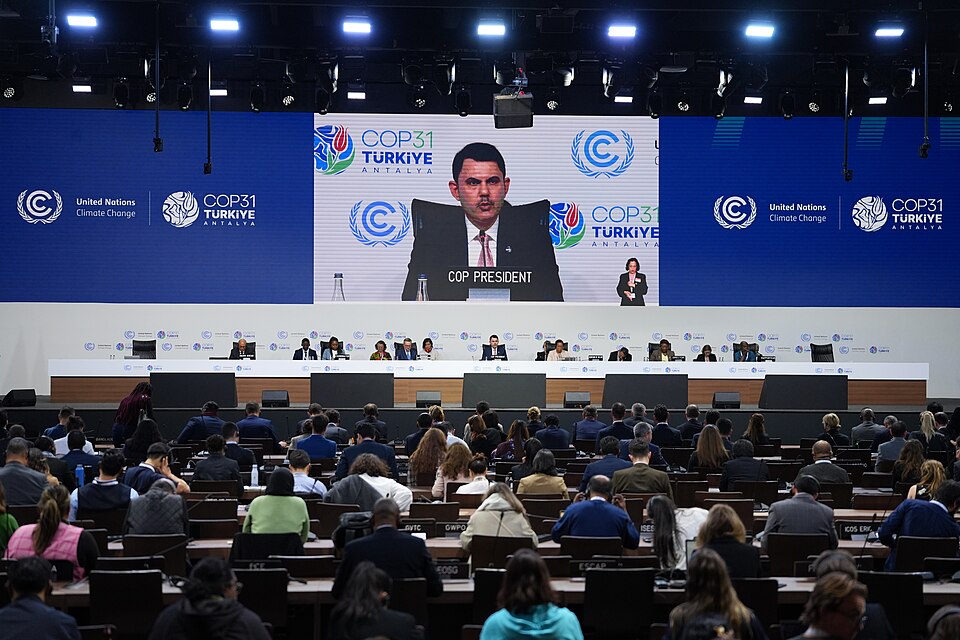
Chris Bowen, Murat Kurum at first Closing Plenary of COP31 (Nov 20, 2026). Image by Xuthoria via wikimedia commons
UN climate talks in Antalya, Türkiye, are set to end without agreement after the EU and others rejected the final deal, which failed to mention fossil fuels.
The All Ireland Science Media Centre asked experts to comment.
Dr Diarmuid Torney, Director, Dublin City University Institute for Climate and Society, comments:
Note: Dr Torney is attending the summit
“Expectations were low going into this COP. The broader context was very challenging. A fractured geopolitical landscape has put global multilateralism under strain, with leaders around the world distracted by an energy and cost of living crisis, regional conflicts, and growing concerns about existential risks posed by AI.
“This was also the first COP to convene against the backdrop of the inevitability of overshooting the critical 1.5 degree Celsius temperature threshold written into the Paris Agreement. That increased pressure and expectation on governments around the world to deliver faster decarbonization.
“That is the backdrop to the collapse of the COP negotiations today. At issue was the world’s collective determination to transition away from fossil fuels, to deliver climate action in a just and fair manner and in accordance with climate science, to fund climate adaptation in developing countries.
“Decisions are made by consensus at COPs, and some Parties were too far apart on key issues. The co-hosts of this COP—Turkiye and Australia—will come in for scrutiny and criticism on how they managed the negotiations. Some of that criticism is fair, but criticism also rests with governments, especially those that stood in the way of global consensus on addressing the climate crisis.
“A bad deal would have been worse than no deal at all. A Cover Decision that failed to reference fossil fuels would have brought the UNFCCC process into disrepute. It’s not quite clear yet where the multilateral process goes from here. In the absence of progress within the UN process, focus will turn to other processes such as next year’s 2nd Transitioning Away from Fossil Fuels conference, which will be co-hosted by Tuvalu and Ireland.”
Declaration of interest: none received
Professor Yvonne Buckley, Co-Director of the Co-Centre for Climate + Biodiversity + Water, Trinity College Dublin, comments:
Note: Prof Buckley is attending the summit
“It now appears that the COP31 talks have collapsed with the fourth draft formally rejected by the EU and others including Panama, who wrote an open letter setting out their red line issues earlier in the process. The COP31 draft text fails to mention the necessity of moving away from fossil fuels as the primary cause of human induced climate change.
“This COP has seen arguments around the use of the best available science; indeed, the scientific foundation of global climate agreements has been under attack. At the same time there has been acknowledgment that we have failed to meet the Paris agreement threshold of limiting warming to +1.5C. It has never been clearer that we need to act to stop the continued use of fossil fuels.
“While it is disappointing that global multilateralism has failed here, perhaps failure is needed to catalyse meaningful action in the future. Ireland and Tuvalu are jointly hosting the Transition Away from Fossil Fuels initiative in 2027, which was established at the Santa Marta COP last year to enable countries serious about the transition to make progress. This has taken on new significance given the failure of COP31.
“Panama’s intervention sought to strengthen the support of science and the need to jointly negotiate the three UN conventions on climate, biodiversity and land degradation. Panama recognises that nature is our first line of defence in combating climate change and its impacts.”
Declaration of interest: none received
Dr Breffní Lennon, Sustainability Institute, University College Cork, comments:
“What is happening in Antalya is interesting on several fronts, not least it is demonstrating that words, and the use of language still matter. We have had, particularly under the Trump presidencies, a situation where words and the language of diplomacy have become largely meaningless in some circles, e.g., Trump’s meeting with Putin in Shenzhen. COP also demonstrates how complex international negotiations actually are.
“The EU has done the morally correct thing, rejecting the draft text. They may have also saved consensus politics by walking away from a bad deal. If they had allowed the petrostates to highjack another COP negotiations and accepted a fudge that does not mention transitioning from fossil fuels, Global South countries and the island nations would have keenly felt the betrayal. Walking away may also finally impress upon the petrostates that they cannot keep forestalling the systemic changes that are needed as we career into climate overshoot. It cannot be business as usual anymore, the petrostates and the fossil fuel lobbies they fund have to finally get real.”
Declaration of interest: nothing to declare
Dr Lisa Sheenan, Assistant Professor in Banking and Finance, University College Dublin, comments:
“The rejection of the proposed COP31 agreement highlights a fundamental conflict between economic credibility and fairness. The failure to reach consensus is disappointing, but agreeing to a deal that fails to address the causes and costs of climate change would hardly represent meaningful progress.
“The EU’s objection to a text that does not explicitly mention fossil fuels is understandable, as is the lack of concrete progress on climate finance. The rejected draft reaffirmed existing obligations and the ambition to triple adaptation finance by 2035, but offered no agreed baseline or credible delivery pathway, despite developing countries’ adaptation needs being estimated at $305 billion annually by 2035.
“From an economic perspective, failing to agree does not make the costs disappear because delaying emissions reductions and underinvesting in adaptation risks greater economic losses and financial instability. This is also a question of climate justice and intergenerational fairness as countries least responsible for historical emissions often face the greatest impacts, while future generations inherit the costs of today’s inaction.
“It’s like refusing to fix a burst pipe while arguing over who should pay for the water damage, then expecting the neighbours downstairs, who didn’t cause the leak, to foot the bill.”
Declaration of interest: no conflicts of interest to declare
Dr Lydia Cumiskey, Research Fellow, Sustainability Institute, University College Cork and European Climate Pact Ambassador, comments:
Note: Dr Cumiskey attended the summit as part of the UCC delegation
“It’s deeply disappointing that COP31 ended without a cover decision. The final text held real gains for building the resilience of those most exposed to climate impacts. It backed the UN’s Early Warnings for All initiative and explicitly linked early warning to early action, anticipatory action and pre-arranged finance. It also called for locally led adaptation responsive to local needs, and for climate-resilient health systems. These gains must not be lost.
“On finance, pledges such as around $50 million for the Adaptation Fund are welcome, but small against adaptation needs estimated at over $300 billion a year. The Belém commitment to triple adaptation finance by 2035 still stands, but agreeing how to measure and deliver it, so that it reaches communities quickly and effectively, is now on hold until COP32 in Addis Ababa.
“As Simon Stiell said in closing, civil society is vital now more than ever. When negotiations stall, our role is to keep building climate action from the ground up and hold leaders to account. Through my role as a European Climate Pact Ambassador, I’ll keep supporting and mobilising this local action. “
Declaration of interest: none
Dr Barry Hayes, Associate Professor, School of Engineering, University College Cork, comments:
“The failure to reach a deal at COP31 is hugely disappointing. However, the EU and other governments were right to reject an utterly pathetic agreement text that could not even bring itself to mention the words “fossil fuels”. In recent times, COP summits have been sabotaged by malicious actors – petrostates and oil companies that seek to disrupt, delay, and block any real attempt at addressing the roots of the climate crisis. After a series of weak, watered-down COP deals, they have secured another victory here in the collapse of the talks with no agreement. The COP summit process is broken. It is difficult to see where it goes from here, and how we can ever achieve a global, consensus-based approach towards the climate crisis. We need to move to system that can exclude those who are only interested in disrupting the negotiations, allowing countries that genuinely want to address climate change get on with their business.”
Declaration of interest: none received