
Airfield Estate hosts Ireland’s first Science Media Centre to counter misinformation in media reporting
25 March 2026
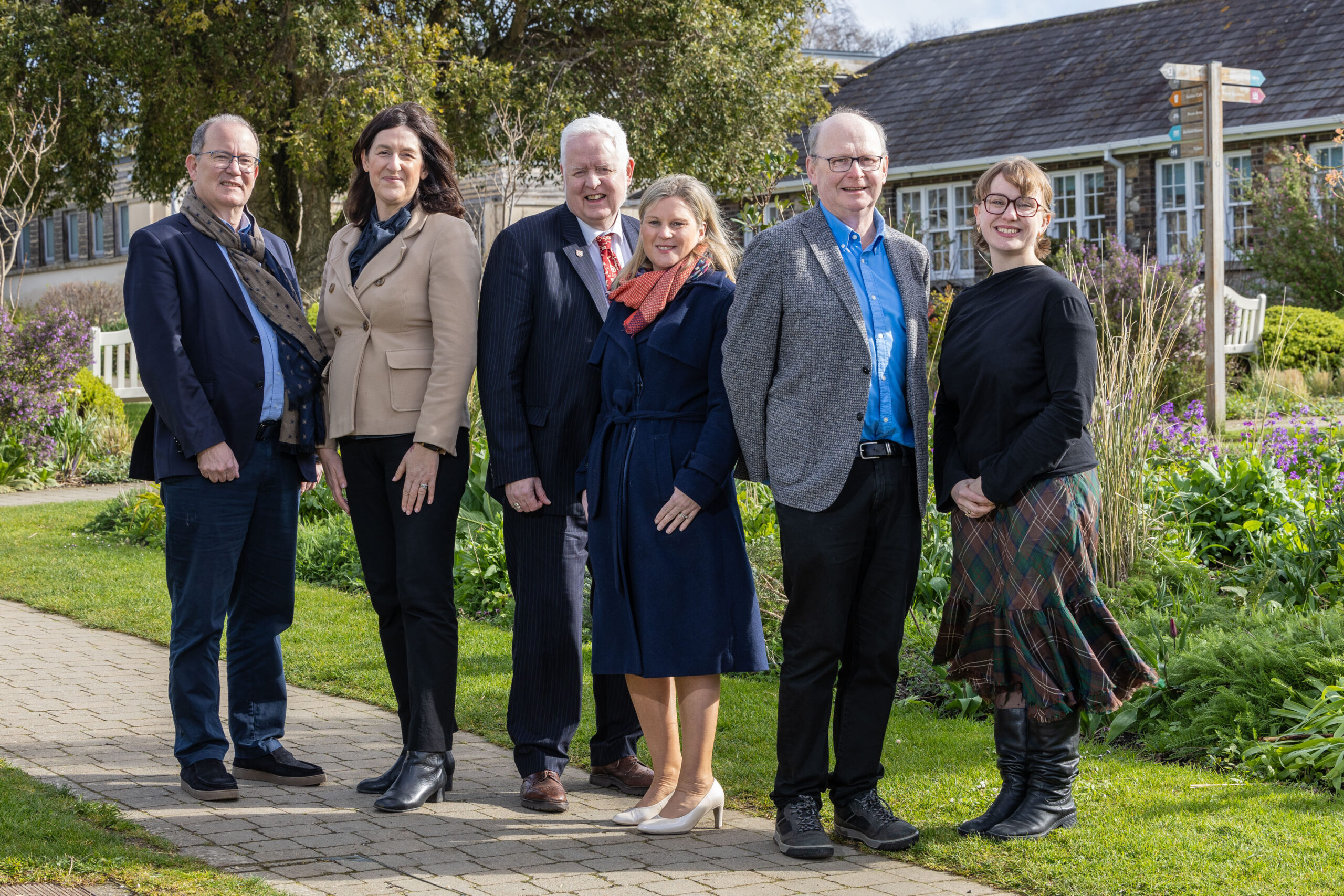
Pictured today at Airfield Estate: Sean Duke, Irish Science & Technology Journalists Association, Claire MacEvilly, Airfield Estate, Professor Mark Lawler, Queen’s University Belfast, Dr. Sinéad Waters, Ryan Institute & University of Galway, Kevin O’Sullivan, former Irish Times editor and Katrin O’Donnell, All-Ireland Science Media Centre.
Participating scientists identify climate change as Ireland’s most urgent issue, followed by AI and misinformation
Today marks a milestone for science communication in Ireland with the official launch of the All-Ireland Science Media Centre, headquartered at Airfield Estate, Dundrum.
The official launch event this morning brought together science communicators, scientists, universities, media, industry, funders, and supporters to celebrate the establishment of this new all-island organisation designed to strengthen accurate, evidence‑based reporting across the island.
Since its inception as a pilot in 2024, over 350 scientists and researchers have joined the expert database with the centre delivering 44 expert reactions to breaking news stories and 31 expert reactions on newly published research.
These insights have supported journalists to accurately report on issues ranging from paracetamol use in pregnancy, methane emissions, weight loss drugs, and breaking news events such as Storm Éowyn.
Claire Mac Evilly, CEO of Airfield Estate and Chair of the All-Ireland Science Media Centre, emphasised the importance of the initiative: “In an era where misinformation spreads faster than ever, the All‑Ireland Science Media Centre will be a crucial link between scientists and the media, improving the accuracy of science in public debate. Airfield Estate is proud to host the Centre, as its mission aligns closely with our work in educating the public on food, climate, and sustainability.”
Ahead of the launch, the All-Ireland Science Media Centre sought the views of Irish and Northern Irish scientists taking part in the initiative.
Key findings were as follows: *
- Climate change, AI, and misinformation are viewed as the top three scientific and societal challenges Ireland faces in the next 3–5 years.
- A quarter (23%) of scientists believe scientific issues are reported poorly in Irish media, while just over half (52%) describe current coverage as average.
- Despite these concerns, scientists expressed strong interest in engaging with journalists. The most common motivations were informing the public (83% of those surveyed) and ensuring their field of expertise is accurately represented (63.2% of those surveyed).
- Over half of respondents (52.8%) cited a lack of time and resources as the biggest barrier to media engagement.
The launch event included an engaging panel discussion co-hosted with the Irish Science and Technology Journalists Association and moderated by Jonathan McCrea, science journalist, and Presenter of Future Proof on Newstalk.
The theme of the discussion is “Why Science Needs a Seat at the Breaking News Desk – Bridging the Gap Between Emerging Evidence and Public Understanding.”
Panellists and contributors include:
- Kevin O’Sullivan, Environmental Consultant, Contributor, and former Editor at the Irish Times
- Dr. Sinéad Waters, Principal Investigator in Microbiology, School of Biological and Chemical Sciences and Ryan Institute, University of Galway.
- Seán Duke, Acting Head of Communications, Maynooth University and Outgoing President, Irish Science & Technology Journalists’ Association;
- Professor Mark Lawler, Professor of Digital Health Queen’s University Belfast, and Co-Lead All Island Cancer Research Institute
- Katrin O’Donnell, Senior Press Officer All-Ireland Science Media Centre
The All-Ireland Science Media Centre now joins a global network of eight centres in the UK, Australia, New Zealand, Taiwan, South Korea, Germany, and Spain and is actively expanding its database. To continue its work, the centre requires sustained funding and welcomes any organisation with an interest in the accurate reporting of science and engineering to join its mission.
*Please note, the All-Ireland Science Media Centre has 350 Irish scientists and researchers on its database, of whom 106 responded to the poll.